


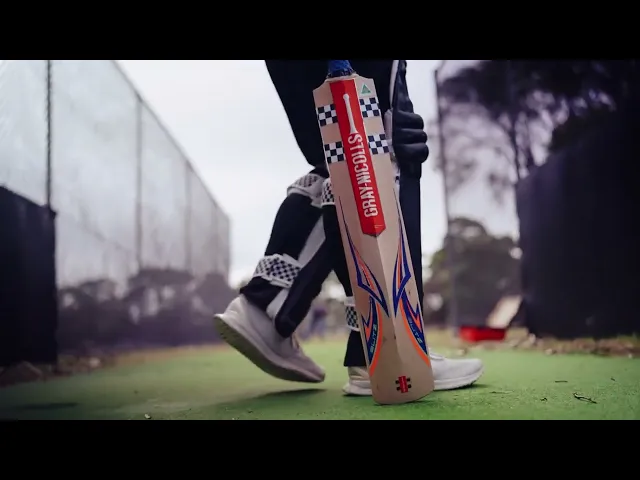
Gray-Nicolls Blitz 500 Ready Play Junior Cricket Bat – English Willow Junior Bat
🏏 Gray-Nicolls Blitz 500 Ready Play Junior Cricket Bat – English Willow Junior Bat
The Gray-Nicolls Blitz 500 Ready Play Junior Cricket Bat is a quality junior English willow cricket bat designed for young players who want a light pickup, fast hands and confident stroke play.
Made from English Willow, the Blitz 500 Junior Bat offers strong value for developing cricketers moving into hard-ball cricket and looking for better feel, balance and performance at the crease.
With a mid-high profile, rounded POWERCURVE face, large edges and a lightweight pickup, this junior bat is ideal for players who like to drive, cut, pull and play attacking cricket with control.
This is a Ready Play cricket bat, meaning it has been factory prepared to reduce preparation time. However, additional knocking-in and gradual net use with an older ball is still recommended before full match use against a leather cricket ball.
📏 Size & Specifications
- Willow Grade: Entry-level English Willow.
- Profile: Mid-high profile
- Bow: Even bow / ultra bow
- Face: Rounded POWERCURVE face
- Pickup: Light pickup / balanced junior feel
- Edges: Large edges
- Sweet Spot: Mid to high sweet spot
- Handle: Junior handle
- Grip: Gray-Nicolls grip
- Toe: Toe protection applied
- Finish: Ready Play finish
- Preparation: Factory prepared with face protection; additional knocking-in and gradual net use recommended
- Cover: Bat cover included
- Use: Junior cricket batting, training, nets and match play after final preparation
- Benefit: Light pickup, fast hands, balance, power and junior batting confidence
- Player Level: Junior, school, club and developing hard-ball cricketers
🔍 Key Features
- English Willow construction for junior performance and strong value
- Mid-high profile suited to attacking stroke play and confident front-foot shots
- Rounded POWERCURVE face to enhance feel and response through the ball
- Large edges to create a generous junior hitting zone
- Light pickup to help young players generate faster bat speed
- Balanced junior shape designed for control, timing and clean ball striking
- Ready Play preparation to reduce preparation time before use
- Factory fitted protection including face protection and toe protection, verify against selected stock
- Ideal for developing batters who want confidence in hard-ball cricket
- Trusted Gray-Nicolls quality for school, club and junior cricket
🎯 Ideal For
- Junior cricketers
- School cricket players
- Junior club batters
- Developing hard-ball cricket players
- Young players wanting an English willow junior cricket bat
- Batters who prefer a mid to high sweet spot
- Players wanting a light pickup and quick hands
- Attacking junior players who like to drive, cut and pull
- Training sessions, net practice and match play after final preparation
- Families looking for a quality Gray-Nicolls junior cricket bat
Gray-Nicolls Blitz 500 Ready Play Junior Cricket Bat – English Willow Junior Bat

- ℹ️ Description
- 📏 Size & Specifications
- 🔍 Key Features
- 🎯 Ideal For
- 🪬 Buying Guide
🏏 Gray-Nicolls Blitz 500 Ready Play Junior Cricket Bat – English Willow Junior Bat
The Gray-Nicolls Blitz 500 Ready Play Junior Cricket Bat is a quality junior English willow cricket bat designed for young players who want a light pickup, fast hands and confident stroke play.
Made from English Willow, the Blitz 500 Junior Bat offers strong value for developing cricketers moving into hard-ball cricket and looking for better feel, balance and performance at the crease.
With a mid-high profile, rounded POWERCURVE face, large edges and a lightweight pickup, this junior bat is ideal for players who like to drive, cut, pull and play attacking cricket with control.
This is a Ready Play cricket bat, meaning it has been factory prepared to reduce preparation time. However, additional knocking-in and gradual net use with an older ball is still recommended before full match use against a leather cricket ball.
- Willow Grade: Entry-level English Willow.
- Profile: Mid-high profile
- Bow: Even bow / ultra bow
- Face: Rounded POWERCURVE face
- Pickup: Light pickup / balanced junior feel
- Edges: Large edges
- Sweet Spot: Mid to high sweet spot
- Handle: Junior handle
- Grip: Gray-Nicolls grip
- Toe: Toe protection applied
- Finish: Ready Play finish
- Preparation: Factory prepared with face protection; additional knocking-in and gradual net use recommended
- Cover: Bat cover included
- Use: Junior cricket batting, training, nets and match play after final preparation
- Benefit: Light pickup, fast hands, balance, power and junior batting confidence
- Player Level: Junior, school, club and developing hard-ball cricketers
- English Willow construction for junior performance and strong value
- Mid-high profile suited to attacking stroke play and confident front-foot shots
- Rounded POWERCURVE face to enhance feel and response through the ball
- Large edges to create a generous junior hitting zone
- Light pickup to help young players generate faster bat speed
- Balanced junior shape designed for control, timing and clean ball striking
- Ready Play preparation to reduce preparation time before use
- Factory fitted protection including face protection and toe protection, verify against selected stock
- Ideal for developing batters who want confidence in hard-ball cricket
- Trusted Gray-Nicolls quality for school, club and junior cricket
- Junior cricketers
- School cricket players
- Junior club batters
- Developing hard-ball cricket players
- Young players wanting an English willow junior cricket bat
- Batters who prefer a mid to high sweet spot
- Players wanting a light pickup and quick hands
- Attacking junior players who like to drive, cut and pull
- Training sessions, net practice and match play after final preparation
- Families looking for a quality Gray-Nicolls junior cricket bat
Things to Look for in Cricket Bats:
Every cricketer has a different option when buying a new cricket bat. The choices are but not limited to
- The size of Cricket Bat - Long blade or Short or Kids,
- Grade of the willow used to make the cricket bat.
- Number of Grains on the cricket bat is another option that some are interested in. The number of grains a cricket bat has can range from about 5 grains to about 15 grains.
- Weight of Cricket Bat.
1. Size of Cricket Bat & Handle:

Most Adult batsman use Short Handle (SH) size of cricket bat but if your height is above 6’1”, then we recommend for you to check out the long handles as an option, although it is a personal choice of the batsman to select size of the handle. For Junior cricketers the bats range from size 1 (smallest) and the largest one is 6 with Small Mens, Youth and Harrow in between Adult and Juniors.
2. Cricket Bat Willow Quality:
Crickets bats are a natural wooden material thus all have different bat characteristics right from balance of the bat, bat pickup and the number of grains and width of grain. As a rule of thumb,
- The softer (narrow grain) willow has excellent performance qualities but shorter lifespan
- The harder (broader grain) willow tends to last longer but takes time before you get optimum performance from it.
- All bats are graded on performance and made from a natural material so the grain structure can vary.
Players Grade Willow - This is the best willow that money can buy. The blade is unbleached and usually has 8-12 blemish free straight grains to a large extent.
Grade 1 willow - High quality unbleached English willow. As above but with a slightly broader grain and sometimes a slight red edge.
Grade 2 willow - Unbleached English willow with some minor blemishes, red wood on the edge and a slight irregular grain.
Grade 3 willow - Some of these bats will be bleached English willow to cover up a more irregular grain and more blemishes.
Grade 4 willow - This will be bleached English willow which is often covered up with a protective facing and sold as "non oil".
Kashmir willow - Found in cricket sets and junior bats. Kashmir willow is harder and dryer by nature than English willow, so doesn't perform as well or last as long. This bat is ideal as a starter bat for use against a softer safety ball (Incrediballs, Wonderballs, e.t.c)

Guide To Buy Cricket Bat: Grains Number
Cricket bat that is mainly manufactured by using high-quality English willow usually will have grains of 6 to 12. The lower the grain the swifter your bat will be, although it increases the time taken by the bat to reach the ultimate performance to knock the ball.
3. Sweet Spot, Shape and Pick Up:


There are a few other different factors which need to kept in mind before choosing any cricket bat..
- Sweet Spot
The sweet spot or middle is generally the cricket bat area that falls between 7 to 10 inches from the toe. It is part of the cricket bat from where players can hit the ball to the maximum distance.
The modern bats have larger sweet spots packed densely with wood. Nevertheless, some bats have a greater sweet spot surface area than others.
HIGH Sweet Spot - Suitable for players who like to play horizontal bat shots, cuts and pull shots. Lighter pick-up.
MEDIUM Sweet Spots - Suitable for players who like to play off the center of the bat. This accounts for 80-90% of batsmen.
LOW Sweet Spots - Suitable for players who like to hit straight. Preference to play ground strokes and off the front foot.
- Curve (Shape)
You might have noticed a curve in a cricket bat. That curve has many functions, including balancing the bat, adding finesse to various shots, and enlarging the sweet spot.
One of the curve's most critical functions is to make playing some of the shots more comfortable to play. It allows players to play shots at angles that would have been impossible otherwise to play.
Another important reason for having a curve is that it increases the bat's sweet spot area without increasing the bat's weight. The combination of weight distribution and curve gives the bat what we call the middle or the sweet spot, so there will be no definite middle without curvature. That’s why you won’t find bats without curves in international cricket.
You can imagine what you might be missing if the bat has less curvature or no curvature at all. If the bat has the same thickness throughout the length, there are chances fast pace deliveries might break it, like in the bats' toes. When a quick ball hits the toe of the bat, it cannot tolerate the ball’s kinetic energy because it contains less wood.
Hence, the toes are easily breakable, and no surprise, they don't play any role in shot-making.
- Weight
The weight of the cricket bat is an essential factor that has enabled power hitting. It directly affects the six-hitting ability of the bat.
The heavier the bat, the longer the ball will go after connecting a hit. And modern players love playing with heavier bats. Hence, they hit more sixes than previous generations.
However, playing with a heavy bat has disadvantages too. It isn’t easy to middle balls with heavier bats as the efforts required to move the bat increases with the weight.
As a guide a light bat will weigh between 2lb 6oz and 2lb 9oz, a medium bat will weigh 2lb 9oz to 2lb 11oz and a heavy bat between 2lb 11oz and 3lb.
4. Toe Guard:

The weakest part of a bat is its toe, so a toe guard needs to be applied to protect that part of the bat. In most of the cases that part of the bat is damaged by Yorker while playing cricket. Even it could split the bat into two pieces if you haven’t provided a toe guard to protect it. In cricket the bat needs to be a tap in the ground, so by applying the toe guard, we can reduce the shock provided to the bat.
No videos configured
Add videos to the product metafield: custom.video
This block will automatically hide when no videos are present on the live site.
Recently Viewed Products
- Choosing a selection results in a full page refresh.
- Opens in a new window.
